
Why?
The crisis affecting the Apennines and Italy’s fragile territories is not an accident, but the convergence point of structural failures, the result of an exponential loss of vision, awareness, willpower, and roots. The need to preserve and capitalize on the Heritage of major cities and high-tourist-demand areas has created a void of expertise and resources across 72% of the national territory, leaving an immense material and intangible wealth without any defense.
Today, this historical marginalization is compounded by two global threats:
- The Climate Crisis, which transforms rainfall into extreme and concentrated events, as demonstrated by the repeated floods in Emilia-Romagna (2023-2024) and the devastating effects of Hurricane Henry (2026) on Sicily, Calabria, and Apulia.
- The Geopolitical Crisis, whose recessionary risk further weakens the Italian economy, jeopardizing funds for conservation and accelerating degradation and abandonment.
Our small but determined mission is to promote a systemic response to this complex and urgent emergency. To create a widespread, indelible, certified, and open digital archive of the most exposed heritage, transforming it from a potential cost into a secure resource—an indispensable foundation for any policy aimed at reconnecting past, present, and future in rethinking the Bel Paese from a perspective of territorial cohesion, regeneration, restoration, safety, and revitalization of inland areas and minor centers.
We document the at-risk heritage of the Apennines, inspired by the work of the Alinari Brothers and the great heritage documentation campaigns carried out in the past by Institutions and Private entities. A digital prevention protocol to reaffirm a new and ancient form of resistance to oblivion.
____
Who We Are
Founded in 2017 by art historians, Cultural Heritage photographers, documentarians, and trainers, the volunteer organization “PIC – Heritage in Common” operates for prevention in vulnerable territories.
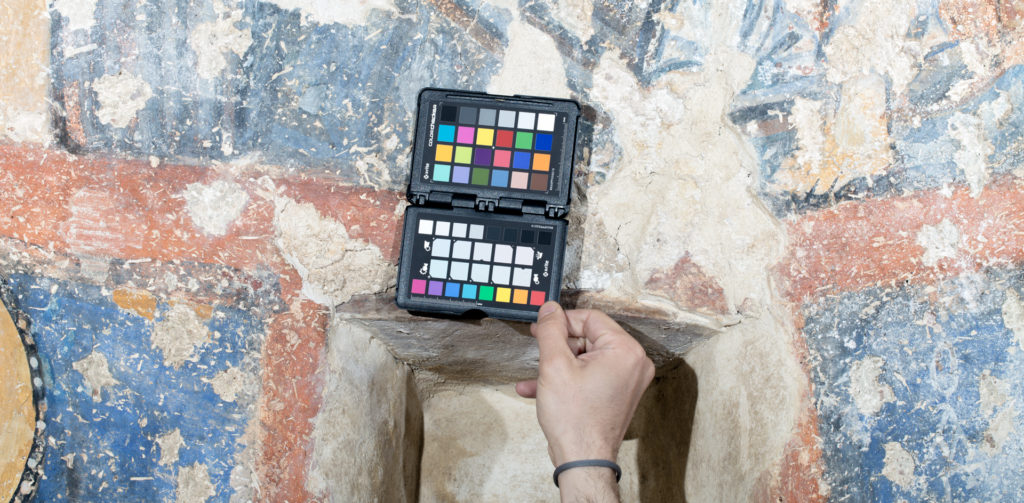
We conduct systematic advanced documentation campaigns (Alinari approach, 2D/3D photogrammetric survey, multispectral diagnostics) using low-cost protocols, making cutting-edge procedures accessible. Alongside this, we carry out institutional awareness-raising and trainingwork to bring the culture of documentation and prevention back to the center of good territorial management practices.
Our work is a pact between technical knowledge and community: technology does not replace but empowers and provides tools to those who live in and guard those places, who are called to its restoration in a spirit of democratization of conservation. Every stone has a soul; we care for both.
____
The Numbers of the Crisis: A Multidimensional Analysis
The vulnerability of the Apennines has many faces. Seismic risk, hydrogeological instability, and depopulation are not separate emergencies but factors that feed each other, eroding the territorial, social, and economic fabric.
Seismic Risk and Failed Prevention
19,779 cultural assets exposed in the Marche region alone (risk zones 1 and 2). Over 700 municipalities in the maximum hazard zone (Zone 1). The PNRR fund for seismic safety spent only 1.6% of the allocated resources (as of 2024).
The PIC Protocol Response
Millimetric digitalization to create the “digital twin” of every relevant asset. An investment costing less than 1% of reconstruction and creating a certain basis for any future intervention.
Hydrogeological Risk & Climate Crisis
Climate change multiplies extreme events, like the floods in Emilia-Romagna (2023-2024) and Hurricane Henry (2025). Waterproofed soils, buried and unmaintained riverbeds, and abandoned slopes amplify the damage.
The PIC Protocol Response
Multispectral diagnostics to map the health status of walls and frescoes before water causes irreparable damage. Preserve to avoid having to (and being able to) reconstruct. 3D photogrammetry helps provide a measurable model of structures and settlements.
Depopulation and Institutional Marginalization
With the new mountain law (Law 131/2025), over 1,100 Apennine municipalities risk losing their “mountain municipality” status: meaning loss of funds, services, and political representation.
The PIC Protocol Response
“Train the trainer” formation and involvement of remaining communities. Technology becomes an engine for social cohesion and a tool to claim the right to care for one’s own heritage.
The Global Context: Recession and Loss of Priority
In a context of geopolitical crisis and recession risk for the entire European Union, “minor” cultural heritage risks disappearing from the budget of national priorities, sacrificed in the name of presumed austerity.
The PIC Protocol Response
Our protocol demonstrates that conservation can be efficient and low-cost. Documentation is a countercyclical investment that protects national wealth in times of crisis, preserving the country’s identity and attractiveness.
We are not facing a mere technical emergency, but a civil challenge. Protecting the material memory of these places means preserving a model of civilization, a grammar of relations between man and the environment, which is the cultural antidote to the drift of our era.
____
Our Approach: Document, Train, Certify
The PIC method develops on three integrated operational pillars, designed to be effective, replicable, and rooted in the territory.
- Advanced Documentation. We use photogrammetry, 3D scans, and multispectral diagnostics to create a high-precision digital twin of each asset. An archive of millimetric data, obtained with low-cost kits, that becomes the basis for study, protection, and restoration.
- Training and Engagement. We organize courses to train local operators and volunteers. The goal is to transform communities into active and aware custodians of their own heritage, creating lasting skills and fostering territorial presence.
- Certified Archiving. All data is stored in a secure digital archive, protected by blockchain technology. This guarantees its authenticity, immutability, and traceability over time, offering an integrity guarantee to institutions and researchers.
____
Join the Call for a Concrete Pact
PIC does not propose simple professional assistance but a constituent pact between technical knowledge and community, between national institutions and local autonomies, to reverse a dangerous course and build resilience.
To Foundations and Private Partners, we ask you to see in this project an investment in Italy’s symbolic and identity capital, the very foundation on which its prestige and global attractiveness rest.
To National and Local Institutions, we ask you to recognize in this protocol a tool for countercyclical economic policy and territorial cohesion. The digitization of heritage erroneously considered “minor” is a critical intangible infrastructure, a time capsule of cultural identity for the country’s survival and rebirth.
To Universities and Research Centers, we ask you to make our Apennine “worksite” an interdisciplinary experimentation laboratory, where different skills collaborate for a common safeguarding goal. Opening workshops, master’s programs, and seminars on the topic is the only way to guarantee the reproducibility and thus the real scalability of the campaigns and the implementation of results.
To the Communities, we ask you to guide us. To tell us what to save first. Our professionalism and technology are at the service of your memory and your capacity to decide the future of your places.
We have a vital need to expand the potential of this mad but necessary project before its mission becomes a great regret, not only for us but for Italy and anyone who cares about its fate.
____
Founders
DAVIDE FRANCESCHINI – Art historian and Cultural Heritage photographer since 2002. Holds a Master’s degree in Architecture and Landscape Photography (La Sapienza) and a European Master’s in History of Architecture (Roma Tre). Formerly a contract professor (La Sapienza) and freelance trainer. Certified EASA STS 02 UAS pilot, Civil Protection volunteer specialized in Hydro and Forest Fire Intervention.
STEFANO CIOCCHETTI – IT specialist specialized in Cultural Heritage Photography (ISIA, Urbino). His work focuses on high-definition (HD) imaging, photogrammetry (3D), virtual tours, and diagnostics. Certified EASA A1-A3 UAS pilot.

VANJA MACOVAZ – Art historian and PhD in Digital Humanities (University of Florence). Specialized in Cultural Heritage Photography (ISIA, Urbino). Runs a specialized studio in Trieste, collaborating with public and private institutions, and is a trainer in archaeological artifact photography at SISBA (4 years). Certified EASA A1-A3 UAS pilot.

MAURO PENNACCHIETTI – Video documentarian, he prefers medium- and long-term projectsthat allow for progressively building a deep connection with the place and the people who inhabit it. He has collaborated with ActionAid. A board member of the association C.A.S.A. – Cosa Accade Se Abitiamo.

JOIN US – We are open to anyone—researchers and professionals, organizations, networks, institutions—who has the skills and desire to contribute with their expertise, networks, resources, ideas, and passion to the growth and mission of this initiative. Contact us, and we will be happy to engage with you.
“Beauty knows how to dwell within destruction” – An anonymous Taoist
____